- Paid client work
- Web app
- Fee management
Paper registers
to one fee desk.
How a fee app I built solo replaced registers and Excel for 300+ students across two preschool branches.
- Role
- Solo software engineer: design, build, ship and support
- Timeline
- August 2026 to now
- Users
- The branch head and front-desk staff at two EuroKids branches
- Stack
- Next.js 15, TypeScript, Supabase Postgres, Vercel
Next.js · Supabase · Postgres
01 · Context
Two branches, two services, hundreds of fee accounts.
EuroKids Kothanur and Kannuru run school transport and daycare alongside the preschool. Every child can hold a fee account for each service, each academic year, and every one of them has a balance someone has to chase.
- 300+students' fees managed
- 2branches, live
- 2services: transport and daycare
02 · The problem
Fees lived in paper registers and Excel sheets.
- Pain point
Balances were worked out by hand every billing cycle.
- Pain point
Finding who was overdue meant checking the registers one name at a time.
- Risk
A correction in a register overwrites what was there. Nothing shows what changed, or who changed it.
03 · Working with the desk
Built around how the front desk already works.
I worked directly with the branch head and the front-desk staff, and shipped in small updates shaped by what they told me after using each one. The aim was never a clever system. It was a screen the desk would rather open than the register.
04 · Decisions
Make the database refuse the mistakes paper allowed.
- Money
Stored as whole paise, never a decimal, so a rupee can never be lost to rounding.
- Payments
Append-only. A wrong entry is voided with a reason, never edited or deleted, so the history stays honest.
- Balances
Pending and overdue are never stored. They are worked out from the payments each time, so they cannot go stale.
- One model
Transport and daycare share one fee-account table, so the money logic exists exactly once.
- Access
Row Level Security is default-deny. Only staff get in, and a teacher sees only their own branch.
- Audit
A database trigger logs every change. No screen can forget to, and nobody can switch it off.
05 · What I built
The whole fee desk, end to end.
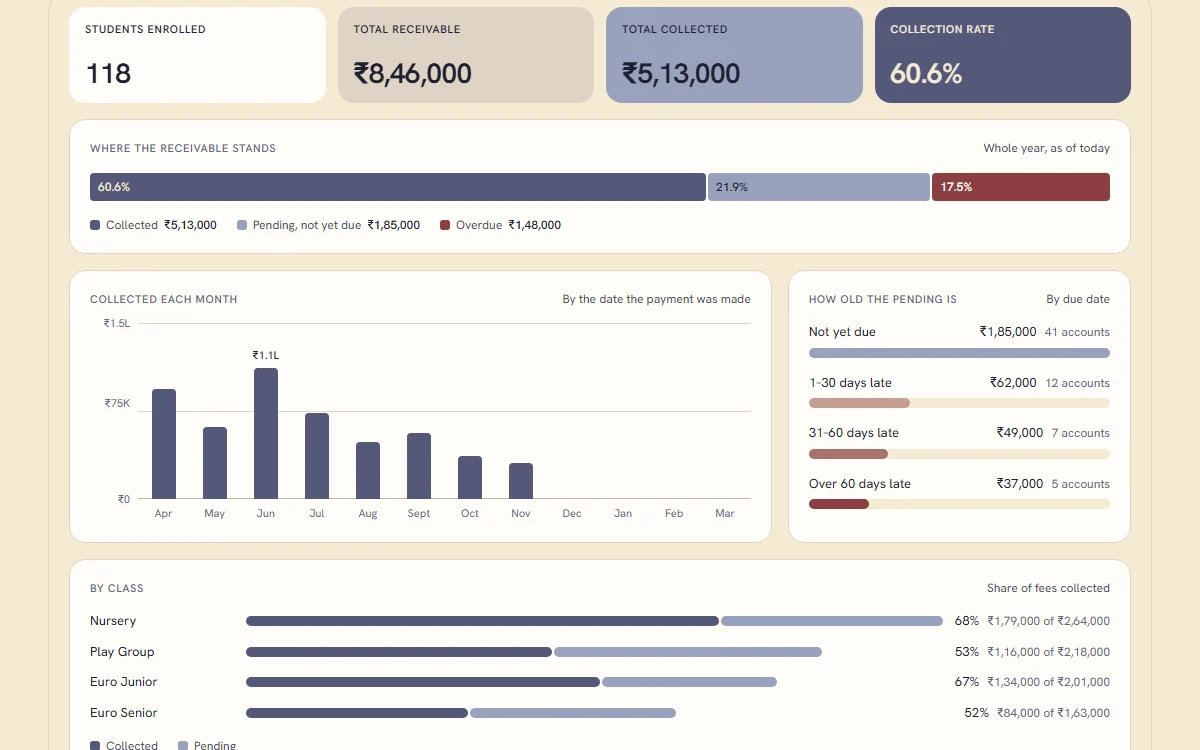
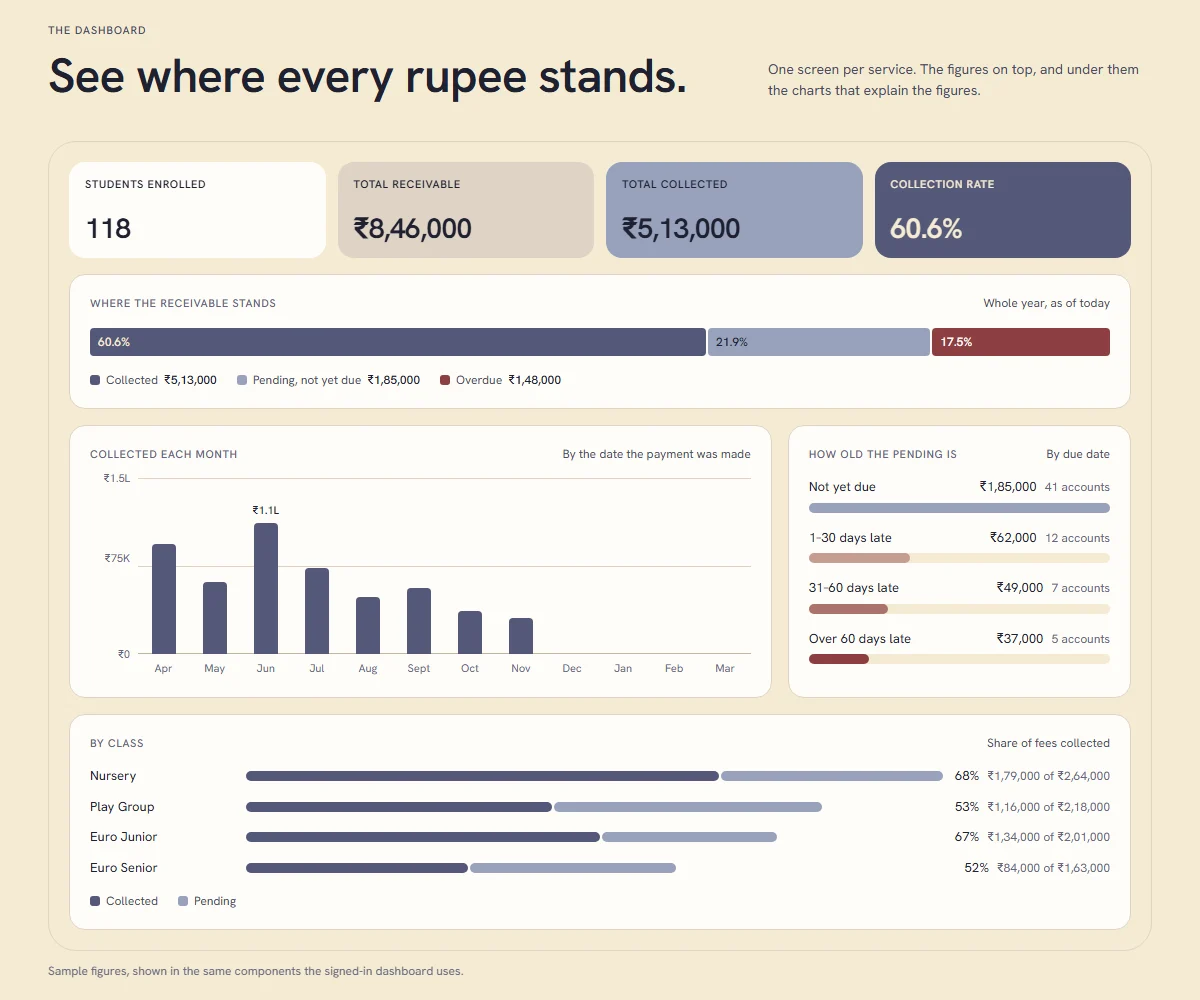
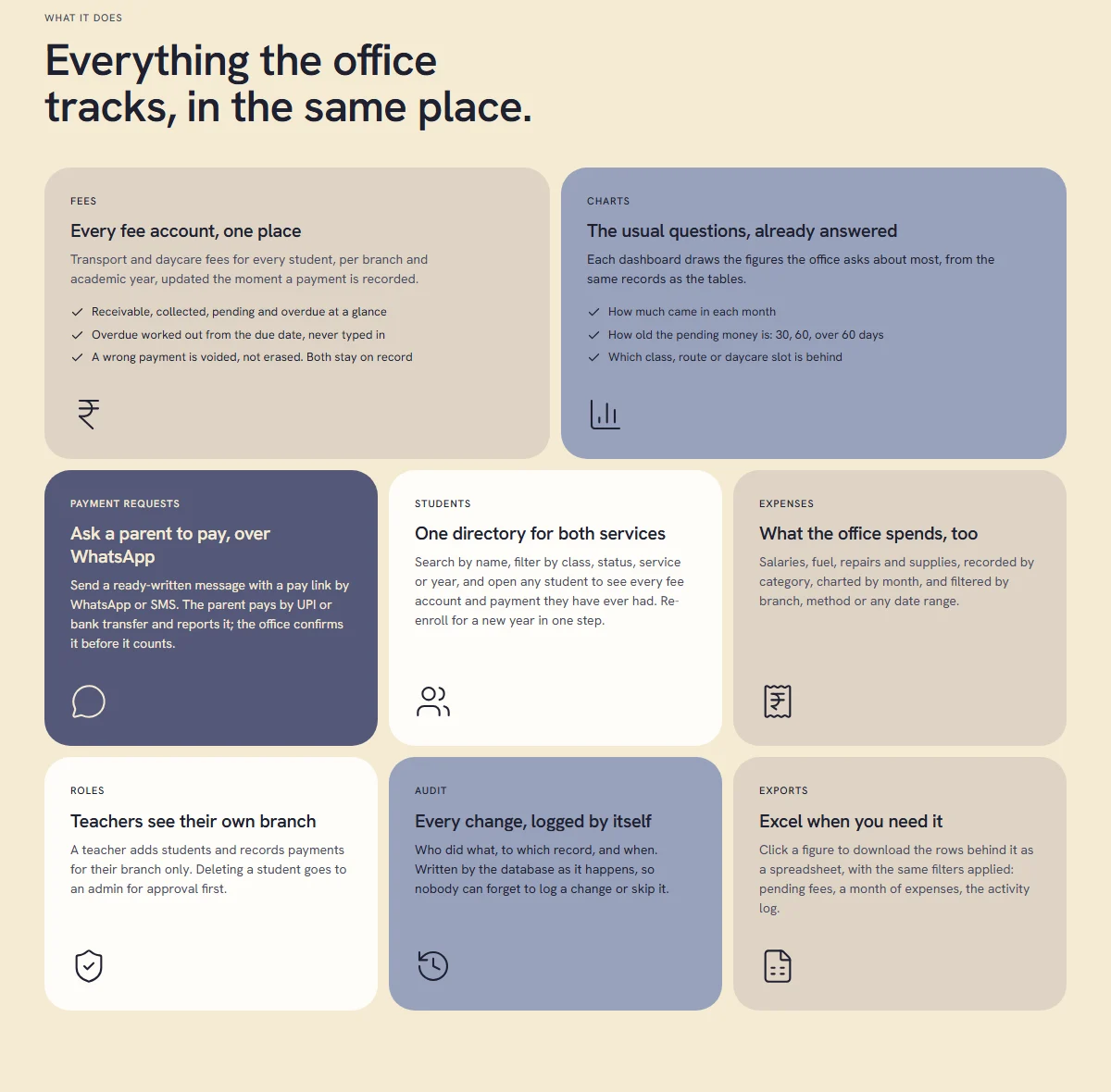
- 01DashboardsOne screen per service: receivable, collected, pending and overdue on top, then charts for what came in each month, how old the pending money is, and which class is behind.
- 02Students and fee accountsOne directory for both services, with every account and payment a child has ever had, and re-enrollment for a new year in one step.
- 03Payment requestsExpiring, tokenized links sent to parents over WhatsApp that open directly in UPI apps. The parent pays and reports it; the office confirms it before it counts.
- 04Expenses and exportsWhat each branch spends, by category and month. Click a figure to download the rows behind it as an Excel sheet.
- 05Two loginsAn admin sees every branch and confirms payments. A teacher works one branch, and deleting a student needs an admin's approval.
- 06Activity logEvery change to a student, account or payment: who, what and when, written by the database itself.
06 · Keeping it safe
It handles other people's money, so it is tested like it.
Money arithmetic lives in one small, framework-free module with its own unit tests. Integration tests run against a real Postgres, and Playwright walks the screens the way the desk does.
- 46versioned Postgres migrations
- 61test suites guarding the payment logic
- 3layers of tests: unit, integration, end to end
07 · Outcome
Live at both branches, and used every day.
Dues calculations and balance tracking that were done by hand are automatic, which saves staff 2-4 hours every billing cycle. Checking who is overdue went from a search through the registers to a list on one screen, and daycare re-enrollment, a front-desk request, trimmed the data entry each new year brings.
- 300+students' fees on EK Desk
- 2branches running on it
- 1 clickto the overdue list
08 · What I took from it
The hard part was never the code.
- Lesson
Sit with the people who will use it before designing anything. Their workarounds are the real spec.
- Lesson
Put the rules in the database. A constraint cannot be skipped the way a checklist can.
- Lesson
Ship small and keep shipping. Trust comes from the tenth update, not the first.
Next case study
ThirdEye: a smart-contract auditor that runs on your laptop
Need a developer
who ships?
Talk to me.
Open to SDE internships and 2027 full-time roles. Remote or relocation.
Download resume1{2 "name": "Tarun Basavaraju",3 "title": "Software engineer",4 "email": "tarunbasavaraju25@gmail.com",5 "phone": "+91 98458 59937",6 "location": "Bengaluru, India"7}